Centre for Ecological Apiculture |
|
Centre for Ecological Apiculture |
 |
Good
for bees and beekeepers, good for mankind and earth. Easy going beekeeping
in the beginning of a new solar Economy - without cruelty to animals,
without frames, supers, artificial compounds in the combs, fossil energy
and nuclear power
"The
noble is animal friendly" Menzius (372 - 289 B.C.)
"What
is necessary above all, is, that you are able to call a spade a spade"
Konfuzius (551 - 479 v. Chr.)
1.
Harmonious Development of the Bee-Colony Instead of Travelling With Bee
colonies, Which is Also Common Among Organic Beekeepers, and Which is the
Reason why Mainstream Organic Bee produce may be Contaminated with Antibiotics,
Communication-System of Bee colonies, CCD, IBDS, Quarks & Co
2.
Variety of Flowers, No Agro-Genetic Engineering and Other Noxious Pollutants
3.
Swarming Impulse is Basis for Breeding - No Artificial Queen breeding
4.
No Instrumental Insemination or Other Artificial Breeding Methods, No Wing
Clipping of the Queen bee
5.
Quality of beeproduce: No Ultra filtration, No Treatment With Heat During
Honey harvest and Filling, No Artificial Honey Comb such as Cassettes Made
of Wood or Plastic ("Bee-O-Pac-System" , "Ross-Rounds", "Hogg's-Cassettes",
"Romanov")
6.
Beehives Made of Natural Materials, No Feeding With Sugar, Syrup, Soymeal,
Milkpowder or Functional Food With Artificially Added Vitamins, Proteins,
No "Clearing Up"
7.
Bees in Top-Bar Hives in the Centre for Ecological Apiculture Drawing Combs
Out Naturally, No Plastic Foundation or Combs, No Artificial Wax, No Pressing-Method
8.
Medicine Against Diseases Made of Compounds that Are Natural Ingredients
of Honey
9.
Bees Know All About their Specialties
10.
On the Character of Bees
11.
Bee produce certified according the Centre for Ecological Apiculture
12.
The Advantage of Top-Bar Beekeeping According Standards of the Centre for
Ecological Apiculture
Making full use of travelling with bee colonies is very common among organic beekeepers; this is a reason why also organic bee produce can be contaminated with pesticides and antibiotics from time to time. More...
We don't need any further kind of industrial beekeeping methods but beekeeping considering the character of bee colonies - in the age of "Solar Economy". Frame hive beekeeping and artificial breeding methods come from past age of fossil energy, which is well known for its overexploitation. "Solar Economy" means learning from Goethe and Beuys; concerning the bees it means no yield increase by frame- and skyscraperhive- beekeeping, plastic combs, foundation and syrup-feeding (Api Review letters 2007, 6, Nr. 195).
An "industrial" beekeeping as it is also common among organic apiaries leads in connection with high insecticide treatments and genetically modified pollen to strange diseases of the honeybee worldwide. The communication system of the beecolony collapses. So called "Colony Collapse Disorder" and IBDS (Idiopathic Brood Disease Syndrome) are the results. On top of that industrial beekeeping help spreading out new parasites such as small hive beetle which is able to ruin the whole apiary. (Apicultural Review letters, vol. 6, No. 116-121 and 10, No. 601).
Web-TV and linklist
on topic Colony Collapse Disorder
Apimondia
Conference in Organic Beekeeping
Sign up for Membership
in Natural Apitherapy Council, Club
of Ecological Beekeepers or support honeybees from cruelty-free beekeeping!
Further reading:
Dangerous
Toxins From Genetically Modified Plants Found in Women and Foetuses - Links
to allergies, auto-immune disease, and other disorders Natural Bt is dangerous;
Bt cotton linked to human allergies, animal deaths; Living pesticide factories
inside us? Science
Review Letters 2011, Vol.10, # 400
The full story of an until now legal poison: Roundup (glyphosate) - Monsanto's Roundup Triggers Over 40 Plant Diseases and Endangers Human and Animal Health. Alzheimer, Parkinson, Cancer Science Review Letters 2011, Vol.10, # 381
Toxic food - not only for cows, sheeps and honeybees - made by Monsanto, Bayer, BASF & Co Api Review Letters 2009, Vol.8, # 351
The five main GM foods are soy, corn, cotton, canola, and sugar beets. Products made of these GM foods such as sugar, high fructose syrup, lecithin are more toxic than expected. Even FDA and EFSA gave wrong testimonials over years; they failed together with many leading politicians Science Review Letters 2009, Vol.8, # 309
GM-crop-Desaster: The US government payments to farmers are up by $3 to $5 billion annually due to GM crops. growers have only been kept afloat by the huge jump in subsidies. genetic pollution caused by today’s GMOs could theoretically outlast the effects of global warming and nuclear waste. Genetically modified sugar beets. Even small amounts of contaminants can be quite dangerous. A brand killed about 100 Americans and caused 5,000-10,000 to become sick or permanently disabled. Science Review Letters 2008, Vol.7, # 202
Biosafety?Unscientific assumptions the basis of approvals? - blatant propaganda exercise stands validated as exemplary science - Toxic gm foods could have been approved. Science Review Letters 2007, Vol.6, # 182
Documentation of US-resistance against genetically modified (GM) foods, genetically modified organisms (GMOs) and review of new scientific research on dangerous and life threatening side effects of modern Biotechnology in: Science Review Letters (2007, Vol.6, #156-159)
Severe side effects of agro-genetic engineering on honeybees and other beneficial insects. See Centre for Foodsafety and grassroot movement "civil courage" in Germany:
Risks
of genetically modified crops on honeybees
http://www.zivilcourage-miesbach.de/Bienen.html
Did you know
that most beekeepers, also from certified organic apiaries (according EU-organic
rule, USDA organic program, standards of most organic associations) let
their queens grow up from worker larvae ("grafting") although it is senseless
from the point of view of the spirit of the beecolony, for which it is
self evident that a queen is only a good queen which has grown up from
the beginning in a special round queen cell with special queen fodder (royal
jelly)?
Did you know
that in many cases beekeepers, also from certified organic apiaries (according
EU-organic rule, USDA organic program, standards of most organic associations)
do not let the queens fly out to their traditional nuptial flight, but
carry out artificial insemination of the queen instead? To prevent the
queen flying out they clip the wings of the queen. Some beekeepers really
think to be on the path of nature by fixing the queen in a special way
on the instrument.
Since August
2003 ultra filtration is allowed also in the EU. What does it mean? With
the help of this technique it is legal to filter out typical honey compounds
- a technique which leads to honey falsification very easily. According
standards of Centre for Ecological Apiculture neither this technique nor
heat treatment during harvest and filling is allowed.
Did you know that honey comb is a produce to which neither mechanical (extraction, stirring procedure) nor heat treatment ("melting") has occurred and which consequently is an product of especially high quality?
Thus there is an increase in popularity regarding honey comb. But always again checking turns out that in parts 90 percent of the honey comb is being criticized. For the most part it is imported honey which contains brood and foundation (sometimes made of paraffin) or is contaminated with antibiotics and beerepellents. On top of that, in many cases you find artificial honey comb, for instance Cassettes made of wood or plastic ("Bee-O-Pac-System" , "Ross-Rounds", "Hogg's-Cassettes", "Romanov") More...
Not only milk powder and glycerine (used for cough syrup or mixtures) from China is poisoned, but als bee produce like propolis, royal jelly, perga, beeswax, honey, who are sometimes being imported from third countries. More than 500 People were already killed. (see also chapter 9)
But also honey comb from Germany is concerned, if it is not produced according our standards. According EU-Rules even artificial foundation in honey comb is allowed.
Thus, where may I
buy pure honey comb? More information and sources of supply for pure
comb in the comb with natural crystallisation (not heated) see below or
under phone: 0049 5652 917899
either of straw
or of wood or clay.
Not allowed
according standards of Centre for Ecological Apiculture are:
Hives, frames, foundations
and combs made of plastic,
wired frames,
artificially created
beewax foundation,
artificial wax foundation,
fibrocement hives
(cement and asbestos),
polypropylene hives
with ultraviolet-resistant stabilizers,
polystyrene, aluminium
sheets, facing of aluminium on the interior (to prevent bees from chewing
soft types of plastic),
rotating frame hives,
"skyscraperhives",
hives, which divide
the colony in fragments (magazines)
No artificial feeding with sugar (from Roundup ready sugar beets), syrup (from genetically modified corn or wheat), soy meal, milkpowder or functional food, no "clearing up"
Did you know that most animals such as cows, pigs, hens etc are being fed with Roundup ready soy? As Roundup ready soy contains glyphosate, it is supposed to be one of the most toxic food for human beings and animals. The same apply to Roundup ready sugar beets. Beekeepers are being using it for feeding their bees.
Did you know that most beekeepers take away the complete honey reserves of the bee colonies - also the honey from the border of the combs in the brood area? They call it the "clearing up"!
Did you know that feeding bees with sugar means feeding with plastik? More...
In contrast to industrial beekeeping and organic beekeeping, feeding sugarmixtures and syrup in apiaries certified by the Centre for Ecological Apiculture, is not allowed. There is left enough honey in the bee colonies for wintertime.
sugarmixtures and syrup used by the majority of beekeepers as winterfodder for bee colonies, contain Glycosesyrupe, which is made from genetically modified raw materials. You can find it in all sweets, marzipan inclusive and even in honey.
By the way, many beekeepers - also those from organic apiaries - are feeding not only sugar syrup but also soymeal, milkpowder and functional food with artificially added vitamins, proteins, iron and so on. Residuals of sugarfeeding as well as residuals of soymeal and milkpowder can be found in bee produce (honey, beesbread, propolis); it doesn't make any difference if they are contaminated with melamin or genetically engineered ingredients or not.
Thus beekeepers - although fighting against genetic engineering - are main supporters of genetic engineering because they use inexpensive sugar syrup and soy meal! On top of that they weaken their colonies by using artificial fodder. More...
On top of that you
can find already genetically modified sugar beets, which accidantly may
have joined the human food chain.
More...
_____________________________
Further
reading and references:
Pollmer,
U. et al. 2007: Lexikon der populären Ernährungsirrtümer.
Frankfurt/Main, Eichborn
Thiele,
M. 2008: "junk produce" also in Bio-Supermarkets? News from the "Lemon-Markets".
Science
Review Letters 2008,
7, # 256
Thiele,
M. 2009: What does "clearing up" mean?. Artificial feeding of honeybees
with sugar syrup, sugar, Soymeal and milkpowder, as it is common among
the majority of beekeepers, does not only support Biotech-Industry. Api
Review Letters 2009,
8, # 327
Centre
for Ecological Apiculture 2009: Classes on how to become a topbar-beekeeper
of the Centre for Ecological Apiculture. Natural beekeeping without frames,
sugarfeeding, cruelty to animals. Api Review Letters 2009, 8, #
325
Thiele,
M. 2012: Gentechnik in Fleisch, Milchprodukten und Honig. Honig mit der
Aufschrift: "Ohne Gentechnik" enthält Pollen von gentechnisch verändertem
Roundup ready Soja. Api Review Letters 2012,
11, Nr. 632
und Dbj 2012, 20, p. 55
Centre
for Ecological Apiculture 2024: Qualität
der Bienenprodukte (Quality of Beeproduce)
Pressemitteilung
Did you know
that the Centre for Ecological Beekeeping is the only Institution in Germany
where bees are being solely kept in top-bar-hives and allowed to draw out
their combs themselves without frames, in contrast to bees from beekeepers
who need to get along with plastic combs in plastic hives, artificial wax
or foundation and wire or even need to live in so called "skyscaperhives"
together with up to six (!) queens per colony - which is practiced
in anti-ecological technique of so called "Pressing-method"? (Api review
letters 2006,
5, 70)
Therefore our Standards are eligible to produce apitherapeutic products like honey comb and honey comb with beebread (especially for those who have an allergy to pollen), as well as 100 % beeswax from naturally built combs (there is no wax-mill who is selling beewax in that quality)
Did you know that
the Centre for Ecological Beekeeping is the only Institution worldwide
who offers Training for becoming a certified apiary of centre for ecological
Apiculture? How does it work? More...
Beekeepers of
Centre for Ecological Apiculture normally don't need medicine against Varroa
mites. How does it work? For hobbyists and sideliners: distance
course and practical on day information courses in the Centre for Ecological
Apiculture: join classes on natural / ecological beekeeping in top-bar-hives
for beginners, gardeners and backyard beekeepers
Please notice: Common frame hive beekeeping and travelling with bee colonies - as it is also common among organic beekeepers - is not suitable for obtaining that quality of bee produce which is needed for apitherapeutical bee produce
Professional beekeepers
may join our Training
in the Centre for Ecological Apiculture.
It is also possible to purchase Top-bar-hives constructed according standards
of Centre for Ecological Apiculture.
If you are looking
for a certified member apiary in your surrounding, please contact Centre
for Ecological Apiculture (adress see below) or see Listing
of bee produce
Everybody is able to support a "long lasting fertility in beekeeping" in contrast to success in artificial beekeeping for a short time. Become a member or support cruelty-free beekeeping!
Did you know that even organic honey is being heated before filling? Did you know that food (meat from pork, poultry, rabbit) and even honey imported from China is sometimes so contaminated with ecologically harmful chemicals and animal medicine like Chloramphenicol (destroys bone marrow of children), that the EU needs to stop the import of animal produce, especially honey from time to time?
According to new scientific research, agriculture and environment contaminate beewax only little. The apiary itself is the source for contamination. One needs to attach the greatest importance to varroa exterminators, and waxmoth exterminator Paradichlorbenzol (PDCB). A heightened Coumaphos-concentration in wax can be even toxic to queens. Bad side effects on brood and health of bees can't be excluded also by lower wax concentrations. The accumulation of Varroazides in combwax leads to a kind of „long-term-therapy" of Varroa, which can cause resistances.
For the time being
there is no uncontaminated beewax on the European market. Such beewax needs
to be imported from Africa - Only in the centre for ecological Apiculture
and its certified member apiaries uncontaminated beewax is being produced,
as these apiaries work completely without foundations and the beewax is
harvested from combs drawn out naturally by the bees. (Apicultural Review
Letters 2006, 5, #32)
For him it was a matter of "long lasting fertility in beekeeping" in contrast to success in artificial beekeeping for a short time. As generally in agriculture, also here apply that it is something different if one gives free play to nature and only bring it on correct tracks or if one carry something artificially in this matter.
You can find interesting comparisons in these lectures, for instance worker bees and bloodcells, drones and nerve cells, bees and wasps (bees as in ancient times breeded wasps); he tells us about the importance of insects in nature (more important than pollination is the distribution of natural formic acid); about swarming, which is a crucial need of the bees (linked to bee poison and three infinitesimal eyes on the forehead, about which science didn't find out the meaning until now - but it's not surprisingly as for the time being only 1 % of the bee's behavioral repertoire has been dicovered and documented by scientists)
He speaks about the relation between brain and formic acid (which can be found in honey and bee poison), and if there is not enough formic acid in the human body, soul and spirit were notable to be kept together.
In other words: Everybody
should be very much interested in beekeeping, "because more than one thinks
human life depends on beekeeping." (Apicultural Review letters 2005,
4,
#1)
In Api Reviev Letters again and again it is reported about mainstream organic / natural beekeeping and if these kind of beekeepers see the point regarding beekeeping considering the character of bees. At least they are good in creating new words: they are speaking about "Organic beekeeping society", "thehealingpath ", "gaiabees", "biohoney", "biobees" „Professional organic beekeeping competence", "Demeter-beekeeping", „Beekeeping according specific species, but easy to handle", „Broodnest as a oneness" and even bee-friendly beekeeping.
A so called "organic" or "natural" beekeeper tells for instance: „organic beekeeping is resting on three pillars, who stand together in an inner connection". One pillar is: „it is good practice in beekeeping to consider the Broodnest as a oneness". You may ask, how many follies need to be quartered in a head until this one may find a place? Neither non-organic nor organic / natural beekeepers consider the broodnest to be a oneness. It’s a pity but it’s a fact. The usage of wired frames, foundation wax, smoke is generally allowed - also by Demeter and Soil Association. What does it mean? Wired pieces of wood together with artificially moulded wax foundations is given to the colony. Only Demeter tries to work with large frames which are completely nonpractical and not solely beefriendly. Demeter lays down in their standards that „Combs and brood need to grow according the development of the colony by combs drawn out naturally, without being disturbed by frames", nevertheless the combs do not end naturally, they are enclosed in wire and frames. Even Warré hives cannot be called beefriendly. [4]
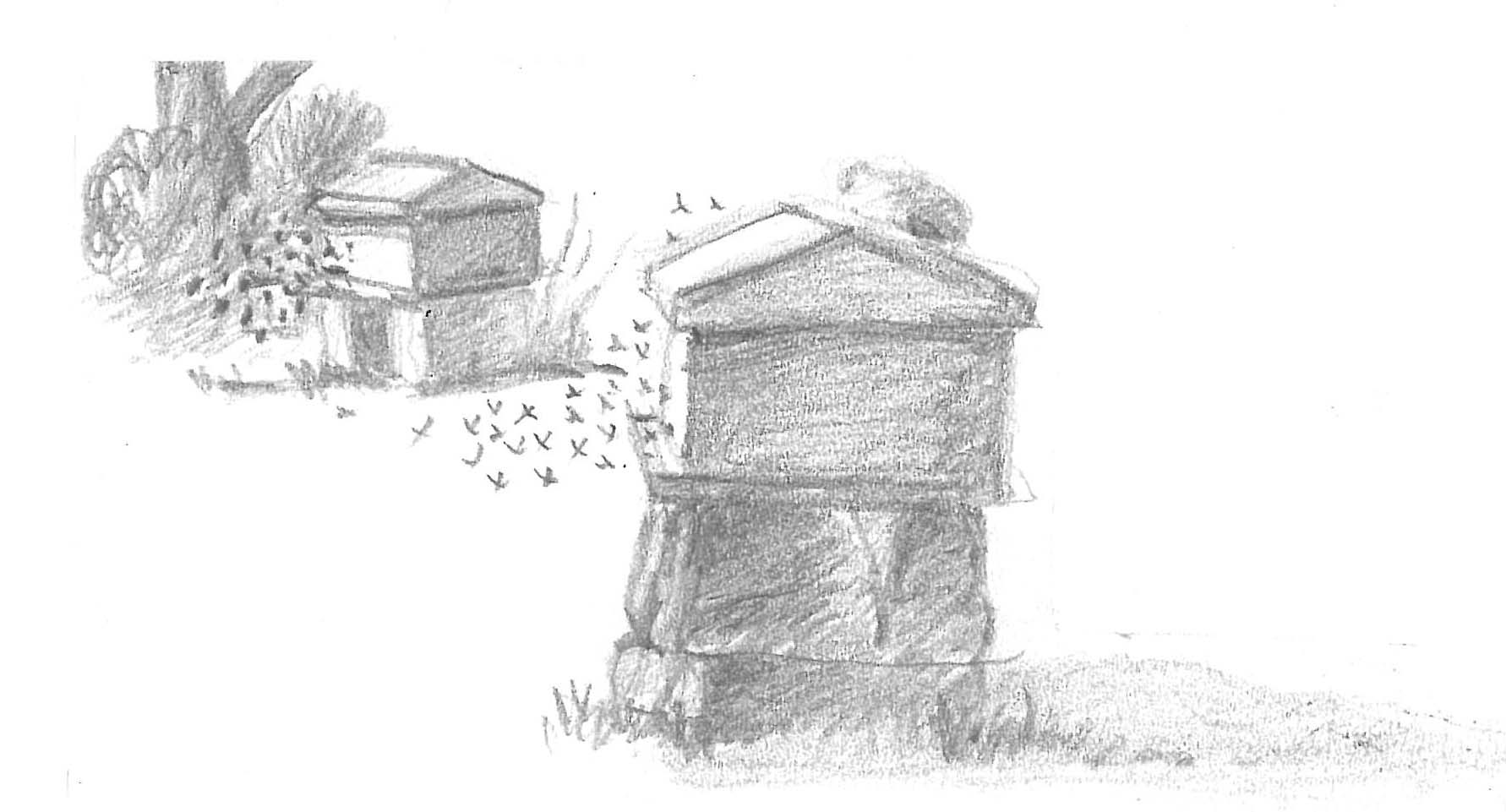
More according beekeeping
considering the character of bees [1] can be called the building of natural
combs for instance in a straw hive or in a Top-bar-hive (movable combs),
as it can be found in apiaries certified according standards of Centre
for Ecological Apiculture. [2] [3][4][5]
_______________________________
[1] Unfortunately
there are many organic beekeeping associations, organisations and authors
who speak about beekeeping according the needs of bee colonies, about natural
and holistic beekeeping but who actually carry out mainstream organic or
even artificial beekeeping methods
[2] Centre for Ecological
Apiculture 2008: Why do the bees swarm? Apicultural Review Letters
2008, 7, # 239.
[3]
Apicultural
Review letters 2005, 4, #.2-4
[4] Thiele, M. 2009:
Bienenkiste,
Warré Hive or Top Bar Hive ? Is the Warré hive really so
simple, sustainable and bee-friendly as maintained by their proponents?
Beekeeping according Warré or standards of Centre for ecological
Apiculture? Apicultural Review Letters 8, # 386, 379
[5] Thiele, M. 2025:
Bienenkiste,
EasyBeeBox, Warré or Top bar hive? - Take which-ever you like best,
but which is the best for beginners, gardeners and backyard beekeepers?
Press release
For grade A bee produce
certification we offer a two
semester training in the Centre for Ecological Apiculture.
Beekeepers
of the
Centre
for Ecological Apiculture
DI. M. Thiele expert in beekeeping considering the character of bees, natural apitherapy, biodynamical agriculture, hazards of agro-genetic engineering and nature conservation
Centre
for Ecological Apiculture / Zentrum fuer wesensgemaesse Bienenhaltung
z.Hd.
DI. M. Thiele
Franzrasen
2, D-37242 Bad Sooden/Germany
Tel:
+49 (0) 5652 917899
Fax:
+49 (0) 32223740527
E-Mail:contact@thiele-und-thiele-consult.de
Web:http://www.thiele-und-thiele-consult.de
Expertise, practical courses, training, distance course:
Distance courses, practical crash-courses organic and beefriendly top bar hive beekeeping, training for beginners and advanced learners
Beeproduce certified according standards of the Centre for Ecological Apiculture
Join
now our campaign supporting honeybees
or become a member
and support the Centre for Ecological Apiculture!
Sign
up for bee-therapy | Beauty-cure
| Anti-aging
| Infertility
| Cancer
of the breast | Hashimoto-Thyreoiditis
|
Crohn's disease
Rheumatism
| Juvenile idiopathic
arthritis | Heart
diseases | Arteriosklerosis
| MS |
Diabetes
| Neurodermitis
| Obesity |
Depression
and Psychosis
Allergies
| Alzheimer
/ Parkinson | Diseases
of the kidneys | Pancreas
| how
to improve fitness of the body
Propolis
| Beeswax | Royal
Jelly | Organic Honey
| Comb in the Comb
| Raw Honey | Organic
Beekeeping Basic Course
Expertise
| Courses | Home
| Research | Save
Beecolonies-Bienenpatenschaft | Certification
| Training
Apitherapy
Api
Review Letters / Science Review Letters
Akademie
der Kunst und Philosophie / Academy of Arts and Philosophy
Save
the Bees, Bumblebees and Beecolonies
Zentrum
fuer wesensgemaesse Bienenhaltung
Centre
for Ecological Apiculture
Forschungszentrum
Bienentherapie / Natural Apitherapy Research Centre
Beetherapy
/ Academy of Sciences
DI.
M. Thiele, President and international Coordinator